Change Language :
Spherical pillow block bearings for use in solar trackers
Lubrication-free tracking for single-axis and dual-axis photovoltaic systems
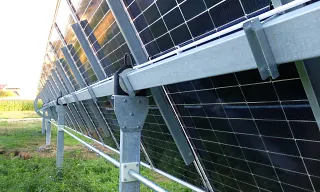
A solar tracker system with first generation spherical pillow block bearings (ESQM-120) guides the solar modules assembled on 120 x 120mm square profiles.
Solar trackers align solar modules with the sun at the most favourable angle throughout the day, significantly increasing energy yield compared to static systems.
The moving components such as the bearing of the module supports are crucial for the efficiency of these systems. The products used must withstand weathering and mechanical loads for decades.
Against this backdrop, we developed our first spherical pillow block bearing made of tribologically optimised high-performance plastics for solar trackers back in 2015: the ESQM.
From introduction to product series
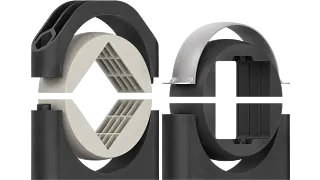
The original ESQM pillow block bearing on the left, the optimised ESQM-2.0 version on the right as the next stage of development.
The launch of the ESQM-120 was followed by further sizes in the years that followed, as well as numerous customer-specific special solutions for various system designs and profile geometries.
The experience gained from these projects has been incorporated into the further development and has made the ESQM a standalone product series.
The common features of all versions are a spherical profile support for compensating misalignments within the solar tracker system and coordinated material combinations that ensure the bearings operate permanently without stick-slip effect.
Development stages of the standard series
2015
ESQM
The starting point of our development was a customer enquiry for a spherical, corrosion-free and heavy-duty bearing solution for solar module tracking. With the ESQM-120, we were able to fully meet these requirements while creating a solution designed for many years of lubrication-free and maintenance-free operation. In addition to other sizes and special solutions, we developed and put into operation an outdoor test rig for long-term tests. The knowledge gained from practical experience and laboratory tests during these years formed the basis for the next development stage.
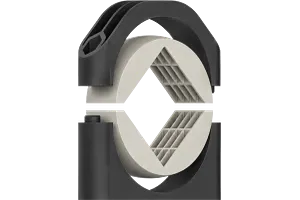
2024
ESQM-2.0
In the second generation, the total height of the component was reduced and the upper housing half replaced by a galvanised extender crossbar, which offers high structural stability despite its material thickness of just 2mm.
The Magnelis® coating protects the metal extender crossbar with self-healing corrosion protection and increases the durability of the component. The lower housing part made of solarmid G and the spherical bearing component made of iglidur P UV use materials with approximately three times higher UV resistance.
In addition, recesses for tidy cable management have been integrated into the profile holder, and the alignment has been switched from a V-shape to a U-shape, whereby the square profile rests more securely in the spherical ball half shell during installation.
Strategic material redistribution also increases structural stability, while the more compact design offers a price advantage over the predecessor model.
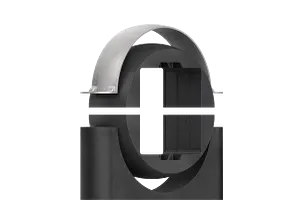
2025
ESQM-2.0-HD
Design study
Two heavy-duty versions were sought for applications with exceptionally high load requirements, such as those caused by storms or snow loads. For the ESQM-2.0-HD, the wall thickness was specifically redistributed to reinforce highly stressed areas, and the thickness of the extender crossbars was doubled. This allows the design to achieve significantly higher structural stability.
ESQM-2.0-HD-HS
Design study
The hard stop version supplements these reinforcements with a mechanical limit to the rotary movement. It prevents impermissible rotations of the tracker axis and thus protects both the axis and the motor from overload or damage.
Are you planning solar trackers for exceptionally demanding wind or load scenarios?
Then take part in our design study and receive further information on the heavy-duty concepts, potential areas of application, and initial technical design data.
2026
ESQM-2.0-LEAN
The Lean version was developed for projects where an economically optimised bearing solution is paramount. It incorporates the design features and appearance of the ESQM-2.0, while using an alternative material with the same structural strength but reduced wear resistance.
The central specifications of lubrication-free and maintenance-free operation, as well as corrosion and dirt resistance, are fully preserved. The material pairing is also still designed for reliable and stick-slip effect-free operation. This results in an economical alternative for cost-optimised solar tracker concepts and applications with defined operating profiles.
Would you like to find out whether the Lean version is suitable for your solar tracker concept?
Project-specific requirements can be sent directly to our specialists via the enquiry form. Each enquiry is technically evaluated individually to support a suitable design for the respective application.
The product highlights of the second generation

Maintenance-free
Thanks to integrated solid lubricants, which replace external lubrication, the pillow block bearing does not require regular service calls

Reduced installation height
The compact design reduces the distance from the bearing to the solar module and thus helps save material in the overall design

High load capacity
Strategic material redistribution leads to a radial load capacity of up to 50kN, as recommended by us
autorenew
Optimised design
Recesses integrated into the profile holder keep the cables organised while the new alignment simplifies assembly

Corrosion protection
The Magnelis® coating offers self-healing corrosion protection that permanently protects the sheet metal bracket from environmental influences

Lightweight
Apart from the galvanised sheet metal bracket, the pillow block bearings of the second generation are made of plastic, which makes them significantly lighter than metallic versions

Dirt resistance
No particles accumulate due to the lubrication-free design, so no wear-promoting paste is formed and the service life increases
line_style
Free of stick-slip effect
Optimally matched materials ensure smooth sliding behaviour without stick-slip effect for quiet, long-lasting operation